
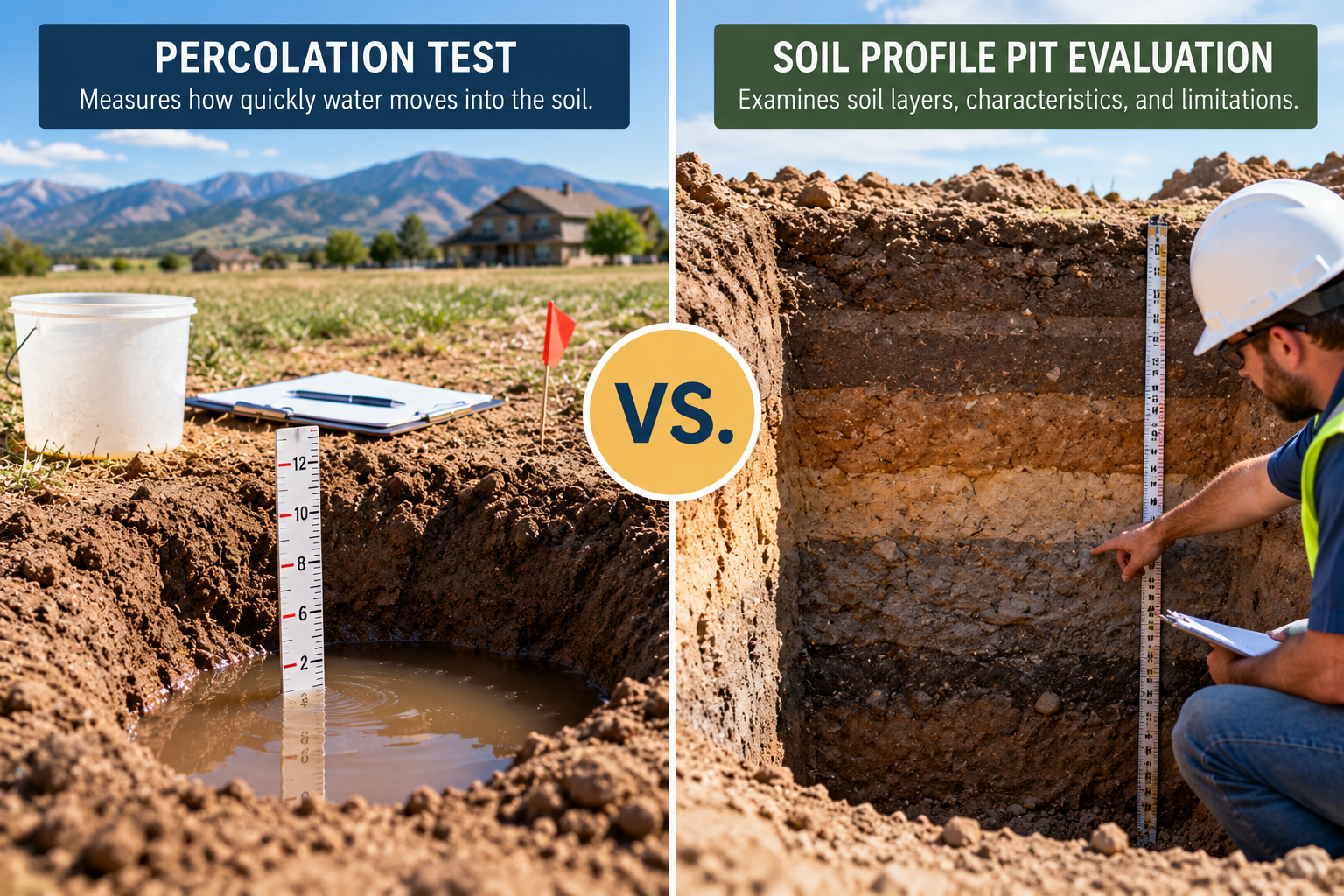
If you’re planning to build a home on rural property in Colorado, there’s a good chance you’ll need to think about something you can’t see from the surface: the soil beneath your land. Before installing a septic system, it’s important to understand whether the ground can properly treat and absorb wastewater. That’s where soil testing comes into the picture. However, if you’ve started researching septic requirements in Hudson, CO, or surrounding Weld County communities, you may have encountered two different terms: percolation tests and soil profile pit evaluations. Although they’re related, they aren’t the same thing.
A percolation test measures how quickly water moves into the soil, while a soil profile pit evaluation examines the soil’s physical characteristics, layers, and potential limitations. Both can provide valuable information for septic system design, but Colorado generally requires soil profile pit evaluations as part of the site investigation. Percolation testing may be performed when additional information about soil permeability is needed.
For property owners preparing for septic installation in Northern Colorado, several important details are worth understanding:
- Colorado’s on-site wastewater treatment regulations generally require a minimum of two soil profile test pits to evaluate proposed septic treatment areas.
- Percolation testing may supplement the soil profile evaluation, but it doesn’t automatically replace the required test pits.
- Soil conditions throughout Weld County can vary, making site-specific investigations important for septic planning.
- Expansive soils, restrictive layers, and groundwater conditions can influence wastewater treatment system design.
- Septic soil evaluations and geotechnical investigations for building foundations serve different purposes, even when performed on the same property.
At High Plains Engineering & Consulting, LLC, we help property owners, builders, and developers understand the ground conditions affecting their construction projects. Based in Hudson, Colorado, our team provides geotechnical engineering, septic pit evaluations, and on-site wastewater treatment system design services. We use site-specific information to develop practical recommendations that account for the property’s conditions and applicable requirements.
What Is a Percolation Test, and How Does It Work?
A percolation test, commonly called a perc test, measures the rate at which water moves into the surrounding soil. For septic design, this information can help evaluate how effectively the ground may accept wastewater discharged into a soil treatment area.
During a percolation test, a qualified professional prepares test holes at appropriate locations and depths. The holes are saturated with water according to the required testing procedure, and the rate of water movement is measured.
Results are commonly expressed in minutes per inch, or mpi. This represents the time required for the water level to drop a specified distance.
Why Does the Percolation Rate Matter?
A septic system relies on the surrounding soil to accept and treat wastewater after it leaves the septic tank. If the soil accepts water too slowly, wastewater may accumulate rather than disperse as intended.
However, extremely rapid water movement can also create concerns because wastewater needs sufficient contact with suitable soil for treatment. The ideal system design must account for both water acceptance and treatment requirements.
For properties near Hudson, Fort Lupton, and Keenesburg, percolation results can provide additional insight into subsurface conditions. However, the numbers alone don’t tell the entire story.
Why Isn’t a Perc Test Always Enough?
A percolation test primarily evaluates water movement under specific testing conditions. It doesn’t independently establish the complete soil profile, seasonal groundwater conditions, or the presence of restrictive layers.
For example, water might move at an acceptable rate near the surface while a deeper clay layer interferes with drainage. A percolation test performed at one depth may not fully reveal that condition.
That’s why Colorado’s septic regulations emphasize direct examination of soil layers through profile pit evaluations.
What Is a Soil Profile Pit Evaluation?
A soil profile pit evaluation involves excavating the ground so a qualified professional can examine the soil layers, textures, structure, moisture indicators, and other subsurface characteristics. This process provides information used to determine whether a location is suitable for an on-site wastewater treatment system.
Unlike a percolation test, which focuses on water movement, a soil profile evaluation examines the physical conditions affecting wastewater treatment.
What Happens During a Soil Profile Pit Evaluation?
An excavator creates a test pit in or near the proposed soil treatment area. A qualified evaluator then examines the exposed soil profile and documents relevant characteristics.
The evaluation may identify:
- Soil texture, including the relative presence of sand, silt, and clay.
- Soil structure and differences between individual soil layers.
- Depth and characteristics of restrictive or limiting layers.
- Evidence of seasonal groundwater conditions.
- Bedrock or other materials affecting the proposed treatment area.
- Appropriate depths for wastewater distribution and treatment.
The evaluator uses these observations to help establish the soil’s long-term acceptance rate, which influences the design and sizing of the treatment area.
In Colorado, soil profile evaluations are an essential part of determining whether the proposed location can support a septic system.
Why Are Soil Layers Important?
Soil conditions can change significantly with depth. A property may have relatively permeable soil near the surface but dense clay, bedrock, or periodically saturated material farther below.
These conditions matter because wastewater needs adequate suitable soil beneath the infiltrative surface to receive appropriate treatment.
A soil profile pit allows the evaluator to examine the materials directly rather than relying exclusively on surface observations or water movement measurements.
For rural properties throughout Weld County, that additional information can be especially useful when determining where to place a septic system.
What Are the Main Differences Between Percolation Tests and Soil Profile Evaluations?
The main difference between a percolation test and a soil profile pit evaluation is the information each provides. A percolation test measures water movement, while a soil profile evaluation examines soil characteristics and limitations that influence wastewater treatment.
Although both are forms of soil investigation, they answer different questions.
Percolation Tests Evaluate Water Movement
Percolation tests help determine how quickly water enters the surrounding soil under the prescribed testing conditions. These results may supplement the soil classification information used to evaluate the proposed treatment area.
Soil Profile Pits Evaluate Subsurface Conditions
Soil profile pit evaluations provide a broader view of the ground beneath the proposed system. They identify soil layers, texture, structure, groundwater indicators, and conditions that may limit wastewater treatment.
Colorado Generally Requires Soil Profile Pits
Under Colorado Regulation 43, site and soil evaluations for proposed on-site wastewater treatment systems generally require at least two soil profile test pit excavations.
Percolation testing may be conducted in addition to these evaluations when further information is needed. When both methods are used and produce different long-term acceptance rates, the more restrictive rate must be used for sizing the soil treatment area.
For Weld County projects, published residential application requirements identify either two soil profile test pits or two soil profile test pits accompanied by three percolation holes.
Understanding these requirements before scheduling excavation can help prevent unnecessary testing or permit delays.
Why Is Soil Testing Especially Important for Rural Colorado Properties?
Soil testing is important for rural Colorado properties because subsurface conditions can vary considerably, even between nearby parcels. Soil texture, groundwater conditions, restrictive layers, and site topography can all influence the suitability of a proposed septic location.
Expansive Soils and Clay-Rich Ground
Some properties in Northern Colorado contain clay-rich soils that expand and contract as moisture conditions change. These expansive soils can create challenges for construction, although their effect on septic design must be evaluated separately from their potential impact on building foundations.
Clay-rich layers may also restrict the movement of water through the soil. Identifying these layers helps determine whether conventional wastewater distribution is appropriate or whether another design approach should be considered.
Seasonal Moisture and Groundwater Conditions
Colorado’s relatively dry climate doesn’t eliminate groundwater concerns. Some properties experience seasonal saturation, localized groundwater conditions, or moisture movement influenced by nearby drainage features.
A soil profile evaluation can identify physical evidence of periodic saturation that might not be obvious during a brief site visit.
Site Layout and Available Space
Septic system placement must also account for property boundaries, wells, buildings, easements, slopes, and other features. A suitable soil treatment area must satisfy applicable setback requirements and provide sufficient room for the selected system.
For someone developing acreage near Hudson or Brighton, evaluating potential septic locations early can help determine where buildings, driveways, and other improvements should be placed.
How Is Septic Soil Testing Different From Soil Testing for Construction?
Septic soil testing evaluates whether the ground can accept and treat wastewater, while geotechnical soil testing for construction examines how the soil will support buildings and other structures. These investigations may involve similar equipment or sampling methods, but their engineering objectives are different.
Soil Testing for Foundations
Geotechnical investigations often involve a soil boring, test pit, or other subsurface exploration method. Engineers may collect samples and perform laboratory testing to evaluate soil characteristics.
The investigation can provide information about bearing capacity, settlement potential, expansive soils, groundwater, and other factors affecting structural performance.
These findings help engineers develop foundation recommendations for homes, workshops, commercial buildings, and agricultural structures.
Soil Testing for Septic Design
A septic soil investigation focuses on the characteristics of the soil treatment area. The evaluator examines soil horizons, limiting layers, and conditions that influence wastewater treatment and dispersal.
Although a geotechnical report may contain useful site information, it doesn’t automatically satisfy Colorado’s septic evaluation requirements.
For property owners planning both a new building and a septic system, coordinating the investigations can be beneficial. However, each evaluation must satisfy the requirements applicable to its intended purpose.
At High Plains Engineering & Consulting, LLC, we provide geotechnical soil testing, foundation recommendations, septic pit evaluations, and septic design services. Our multidisciplinary experience allows us to consider the different engineering needs associated with developing rural properties.
What Happens After Your Septic Soil Evaluation Is Complete?
After a septic soil evaluation is complete, the findings are documented and used to determine an appropriate wastewater treatment system design. The results help establish the soil treatment area’s location, required size, and other design considerations.
Reviewing the Soil Findings
The evaluator prepares documentation describing the observed soil conditions and relevant site characteristics. This information may include soil classifications, limiting layers, groundwater indicators, test locations, and applicable acceptance rates.
Selecting a Septic System Design
The designer uses the evaluation results to determine which wastewater treatment approach is suitable for the property.
Depending on the conditions and regulatory requirements, options may include conventional rock-and-pipe systems, chamber systems, drip dispersal systems, or other approved alternatives.
We design on-site wastewater treatment systems for residential, commercial, agricultural, and industrial applications. Our experience includes conventional systems, Infiltrator chamber systems, non-pressurized drip dispersal systems, and evapotranspiration systems.
Preparing for Permit Review
The proposed design and supporting documents are submitted to the applicable local public health agency for review. In Weld County, the Department of Public Health and Environment oversees the county’s on-site wastewater treatment permit process.
Permit approval depends on the completed application, site conditions, proposed design, and applicable requirements. Additional information or revisions may be necessary before construction can proceed.
When Should You Schedule a Professional Septic Soil Investigation?
A professional septic soil investigation should be scheduled early in the planning process, ideally before finalizing building placement or committing to a particular septic system layout. Evaluating the soil beforehand can help identify site limitations that may affect the overall development plan.
Consider arranging an evaluation when you’re:
- Purchasing rural property and evaluating its development potential.
- Planning a new home that won’t connect to a municipal sewer system.
- Replacing or upgrading an existing septic soil treatment area.
- Developing a commercial or agricultural property requiring on-site wastewater treatment.
- Working with land that may contain restrictive layers or challenging groundwater conditions.
- Preparing permit documentation for a new septic installation.
For property owners throughout Hudson, Fort Lupton, Brighton, and nearby communities, identifying these requirements early can help streamline coordination between the property owner, designer, excavator, and permitting authority.
Frequently Asked Questions About Septic Soil Testing in Hudson, CO
1. Is a percolation test required for every septic system in Colorado?
No, Colorado does not require percolation testing for every septic system. Regulation 43 generally requires a site and soil evaluation that includes soil profile test pits. Percolation testing may be used to provide additional information when appropriate, and local public health agencies may have additional requirements.
2. How many soil profile pits are required for septic design in Weld County?
Weld County’s published residential application requirements generally call for at least two soil profile test pits in the proposed treatment area. When percolation testing is included, the county identifies two profile pits and three percolation holes. Additional evaluation may be necessary depending on site conditions.
3. Can I use a foundation soils report for septic design?
A foundation soils report may contain useful geotechnical information, but it doesn’t automatically replace a septic-specific soil evaluation. Septic investigations must address soil treatment requirements, limiting layers, groundwater conditions, and other factors relevant to wastewater dispersal. The local public health agency determines whether existing information is acceptable.
4. What happens if my property doesn’t pass a percolation test?
Unfavorable percolation results don’t necessarily mean a property can never support an on-site wastewater treatment system. A qualified designer may evaluate alternative system configurations or technologies, depending on the soil conditions and applicable regulations. Some properties, however, may have limitations that prevent a feasible design.
5. Do expansive soils affect septic system design in Colorado?
Yes, expansive or clay-rich soils can influence wastewater movement and septic treatment area suitability, depending on their characteristics. However, soil expansion also has separate implications for foundations and other structures. Site-specific testing helps engineers evaluate each concern using the appropriate design criteria.
6. Who can perform septic soil evaluations in Weld County?
Weld County requires site and soil evaluations to be conducted by or under the direct supervision of appropriately qualified professionals, such as professional engineers, professional geologists, or approved competent technicians. The evaluation must satisfy the county’s current on-site wastewater treatment regulations and applicable professional qualification requirements.
Start Your Septic Project With the Right Soil Information in Hudson, CO
Whether you’re purchasing rural land, building a new home, or planning a commercial or agricultural development, understanding the soil beneath your property is an essential part of septic system planning. Percolation tests and soil profile pit evaluations provide different types of information, and knowing how they work together can help you better understand Colorado’s wastewater treatment requirements. From identifying restrictive soil layers to evaluating potential groundwater concerns, a thorough investigation provides the information needed to develop a septic design suited to the property’s actual conditions. Starting with the right testing can also help prevent avoidable changes later in the construction process.
At High Plains Engineering & Consulting, LLC, we’ve provided engineering services for residential, commercial, industrial, and agricultural projects since 2006. Our team offers septic pit evaluations, soil investigations, on-site wastewater treatment system design, and geotechnical engineering services throughout Hudson, Weld County, and surrounding Colorado communities. Whether you need a septic-specific soil evaluation or broader soil testing for construction in Colorado, we’re ready to discuss your project’s requirements and help you understand the appropriate next steps. Contact us today online or at 303-857-9280 to discuss your soil testing and septic design needs.