
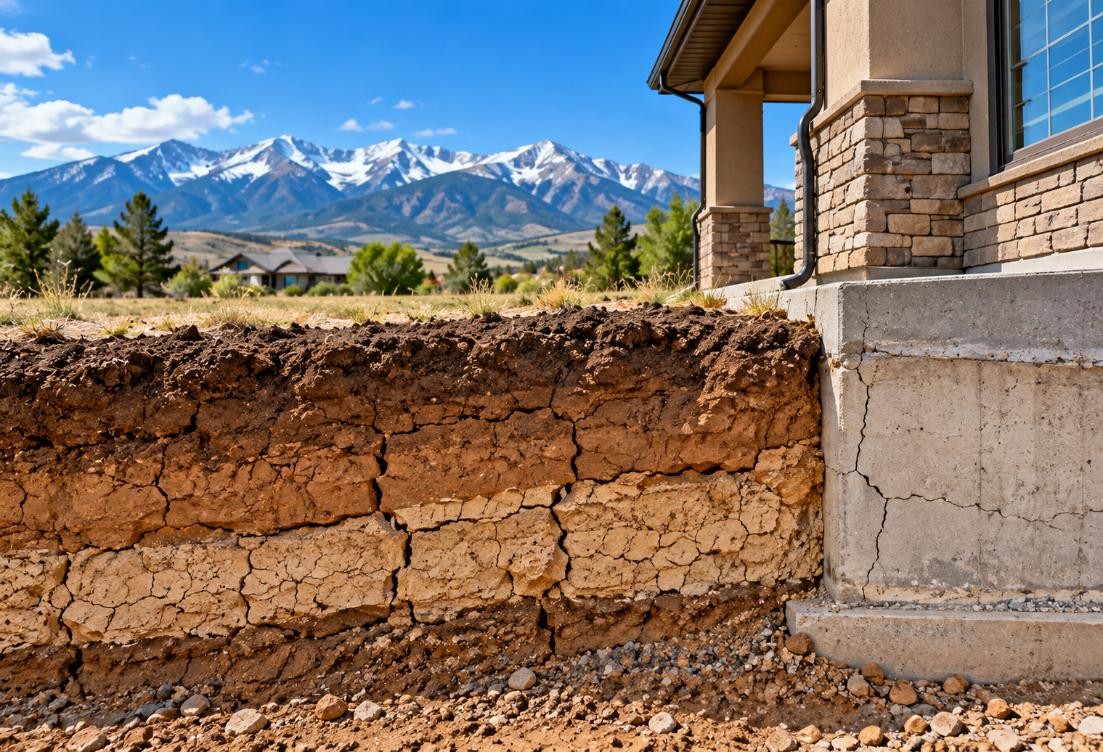
Homes and building sites along Colorado’s Front Range can look stable at the surface while the soil below responds dramatically to changes in moisture. For homeowners, builders, and property owners in Hudson and surrounding Weld County communities, understanding expansive soil before construction or after signs of movement appear can help guide better decisions.
Expansive soils contain clay minerals that increase in volume when they absorb water and may shrink as they dry. In Colorado’s relatively dry climate, repeated changes in soil moisture can create movement beneath foundations, slabs, driveways, utilities, and other improvements. The presence and severity of expansive soil cannot be determined reliably from appearance alone. Site-specific geotechnical evaluation is the appropriate way to understand conditions at a particular property.
What Local Readers Should Know
-
Expansive soil is a recognized geologic hazard across Colorado, particularly along portions of the Front Range.
-
Hudson is located in Weld County between the high plains to the east and the Front Range communities to the west, so regional soil conditions deserve consideration during development and construction.
-
Water is a major factor because expansive clay changes volume as its moisture content changes.
-
Cracks or movement do not automatically prove expansive soil is the cause because settlement, drainage, construction details, and other conditions may produce similar symptoms.
-
Builders should use site-specific geotechnical information rather than assuming neighboring lots have identical subsurface conditions.
Why Expansive Soils Matter in Hudson and Weld County
Expansive soils matter locally because Colorado’s semi-arid climate can produce significant swings between dry soil conditions and periods of added moisture from storms, snowmelt, irrigation, plumbing leaks, or drainage changes. Those moisture variations can cause susceptible clay beneath a structure to swell or shrink, resulting in uneven ground movement.
The Colorado Geological Survey describes swelling soil as one of Colorado’s significant geologic hazards and notes that expansive clay occurs throughout populated portions of the Front Range. The agency also emphasizes that actual soil behavior varies by location and should be evaluated by qualified professionals.
Hudson sits near the intersection of Interstate 76 and Colorado State Highway 52 in rural Weld County. Nearby communities such as Lochbuie, Keenesburg, Fort Lupton, Brighton, and Greeley are part of a broader northern Front Range and high plains development environment where site conditions, drainage, and foundation design all deserve careful consideration.
For property owners seeking local engineering guidance, High Plains Engineering & Consulting, LLC is located in Hudson, Colorado. We approach soil-related concerns by focusing on the conditions of the individual site rather than assuming that a regional soil designation tells the entire story.
Local Data and Colorado Geologic Guidance
Colorado Geological Survey guidance confirms that expansive soils contain clay minerals capable of swelling when wetted and shrinking when dried, with moisture changes being central to their behavior. The agency also identifies improper drainage, excessive irrigation near foundations, and failure to account for soil conditions during design and construction as factors that can worsen problems.
For construction in unincorporated Weld County, current residential permitting materials include geotechnical soil information and engineered foundation documentation among applicable submittal requirements. Requirements vary by property and jurisdiction, so owners and builders should verify the rules that apply to their specific project before construction begins.
These regional requirements and geologic resources are valuable screening information, but neither replaces investigation of the actual building site.
How Expansive Soil Can Affect a Local Property
Expansive soil can affect a local property by producing differential movement beneath foundations, concrete slabs, flatwork, and buried improvements as moisture conditions change. Movement is especially concerning when one portion of the supporting soil becomes wetter or drier than another, creating uneven rather than uniform changes.
For homeowners, that movement may show up as cracking, sticking doors, distorted finishes, or changes in concrete elevations. Builders may face additional consequences if soil conditions are discovered after foundation plans, grading, drainage, or utility layouts have already been established.
Around Hudson, drainage planning deserves particular attention because changes made during development can alter where water collects and how it moves through the soil.
Warning Signs of Possible Soil Movement
Possible signs of expansive soil movement include recurring cracks, uneven slabs, and building components that shift over time, but these symptoms require professional evaluation because several different conditions can produce similar damage.
Watch for:
-
New or widening cracks in foundation walls or interior finishes.
-
Basement or garage slabs that appear to lift or become uneven.
-
Doors or windows that repeatedly stick after previously operating normally.
-
Separation between walls, ceilings, floors, or trim.
-
Cracked or displaced driveways, patios, sidewalks, or other flatwork.
-
Noticeable changes in drainage or ponding near the foundation.
-
Soil that develops pronounced cracks during dry periods and becomes very sticky when wet.
-
Damage that appears to worsen after major changes in irrigation, landscaping, plumbing, or drainage.
A single crack is not a diagnosis. Patterns, timing, construction type, drainage, and subsurface conditions all matter.
When to Call a Professional
A professional evaluation is appropriate when movement appears progressive, affects structural components, occurs repeatedly, or is being considered during the design of a new building. Homeowners can safely observe drainage and document visible changes, but diagnosing subsurface soil behavior generally requires engineering judgment and, when appropriate, geotechnical testing.
For a new Hudson-area project, soil evaluation is most useful before foundation design and major site work are finalized. For an existing home, photographs, crack measurements, drainage observations, and information about recent landscaping or plumbing changes can provide helpful context.
Professional review becomes more important when movement involves multiple areas of the structure rather than a single cosmetic finish.
Common Local Causes of Expansive Soil Problems
The most common triggers for expansive-soil movement involve changes in moisture, particularly when water reaches susceptible clay unevenly around a structure.
1. Poor surface drainage: Water that ponds beside a foundation or repeatedly flows toward the building can increase soil moisture in localized areas.
2. Irrigation near the foundation: Lawn irrigation, drip systems, and heavily watered landscaping may introduce moisture where previously dry soil supported the structure.
3. Plumbing or utility leaks: A concealed leak can create a concentrated wet zone beneath or beside a slab.
4. Seasonal moisture changes: Colorado’s semi-arid conditions can allow soils to become dry before rain, snowmelt, or irrigation increases moisture again.
5. Construction changes: Excavation, grading, fill placement, and altered drainage patterns can change the moisture environment and engineering behavior of a building site.
The Colorado Geological Survey specifically identifies moisture management and appropriate design as key considerations for properties with swelling soil.
Prevention and Maintenance
The best prevention strategy is to manage water consistently and base construction decisions on site-specific soil information rather than assumptions about the neighborhood. Homeowners cannot change the underlying geology, but they can often reduce unnecessary moisture fluctuations around a structure.
Keep roof drainage directed appropriately away from the foundation, maintain positive surface drainage where designed, and watch for ponding after thunderstorms or snowmelt. Inspect irrigation systems for leaks and avoid making major landscaping or watering changes near the structure without considering how they may affect soil moisture.
Builders should coordinate grading, drainage, geotechnical recommendations, and foundation design early in the project. DIY maintenance should stop where structural movement, foundation design, excavation, or subsurface diagnosis is involved.
What to Expect From a Geotechnical Evaluation
A geotechnical evaluation can help determine the soil conditions at a specific building site and provide engineering information for design or problem-solving. Depending on the project, the process may include subsurface exploration, soil sampling, laboratory testing, review of groundwater or moisture conditions, and recommendations related to foundations, slabs, earthwork, or drainage.
Testing may consider properties such as moisture content, soil classification, plasticity, and swell potential where appropriate. The scope should match the type of structure and the questions that need to be answered.
The result is not a guarantee that movement will never occur. It is a technical basis for making better-informed design and construction decisions.
Common Mistakes to Avoid
Common mistakes involving expansive soil usually come from treating a complex site condition as if one simple rule applies everywhere.
Mistake: Assuming a nearby soil report applies to your lot.
Consequence: Soil and subsurface conditions can change over relatively short distances.
Better approach: Use site-specific information when foundation or construction decisions depend on soil behavior.
Mistake: Adding large amounts of water near a foundation.
Consequence: Uneven wetting can contribute to differential soil movement.
Better approach: Manage irrigation and drainage carefully around the structure.
Mistake: Treating every crack as proof of expansive soil.
Consequence: The actual cause may be overlooked.
Better approach: Evaluate the entire pattern of movement and relevant site conditions.
Mistake: Waiting until construction starts to consider soil conditions.
Consequence: Foundation, grading, or earthwork changes may become more complicated.
Better approach: Address geotechnical considerations during planning and design.
A Common Hudson-Area Scenario
A common Hudson-area scenario begins with a residential building site that appears dry and firm during initial planning, followed by changes in moisture after grading, landscaping, irrigation, or occupancy. If susceptible clay is present, those new moisture conditions can change how the soil behaves beneath slabs or foundations.
This is a general scenario, not a case study. The important lesson is that surface appearance does not establish whether a parcel contains expansive soil or how much movement could occur.
A site-specific investigation allows homeowners and builders to make decisions based on conditions beneath the proposed structure instead of regional assumptions.
Related Engineering and Geotechnical Solutions
Engineering and geotechnical services can help identify soil conditions, evaluate observed movement, and support foundation, grading, or construction decisions when expansive soil is a concern. The appropriate service depends on whether the property is still in design, under construction, or already experiencing possible movement.
We can help property owners understand what type of evaluation may be appropriate for the question they are trying to answer.
Comparing Your Options
Choosing between observation, professional evaluation, and immediate corrective work should depend on the type and progression of the problem rather than the appearance of a single crack.
Minor cosmetic cracking that remains unchanged may simply be documented and monitored. Repeated or progressive movement may justify an engineering evaluation. New construction presents a different situation because geotechnical information can influence design before the structure is built.
Attempting repairs before identifying the cause can also be counterproductive. Replacing drywall, leveling concrete, or modifying drainage may address a symptom without resolving the condition producing the movement.
For builders, the strongest approach is generally to investigate soil conditions early enough that the findings can inform design decisions.
Service Areas
We serve property owners and project teams in Hudson and surrounding northern Front Range and Weld County communities. Depending on project needs, that may include areas near Lochbuie, Keenesburg, Fort Lupton, Brighton, Greeley, and the I-76 corridor.
Project scope and site location should always be confirmed before assuming a particular service or investigation is appropriate.
The Cost of Ignoring Possible Soil Movement
Ignoring possible soil movement can allow a manageable condition to become more complicated if moisture changes or structural displacement continue unchecked. The biggest risk is not that every crack will become severe, but that owners may repair visible symptoms repeatedly without understanding why they are occurring.
For homeowners in Hudson, early documentation can make professional evaluation more useful. Builders can reduce uncertainty by addressing soil and drainage questions before construction decisions become difficult to change.
The goal is informed action, not unnecessary alarm.
Frequently Asked Questions
Are expansive soils common around Hudson, Colorado?
Expansive soils are a recognized concern across portions of Colorado’s Front Range and plains, but regional occurrence does not prove that a particular Hudson property has expansive soil. Individual sites can vary. A geotechnical investigation is the appropriate way to characterize soil conditions when they will affect design or construction decisions.
How do I know if my Weld County property has expansive soil?
The reliable way to determine whether your Weld County property contains potentially expansive soil is through appropriate geotechnical investigation and testing. Surface appearance and neighboring properties can provide clues, but they cannot establish the conditions beneath your specific foundation or proposed building area.
Does cracked concrete mean expansive soil is damaging my home?
No. Cracked concrete can result from shrinkage, settlement, temperature effects, construction details, drainage problems, expansive soil, or combinations of factors. The location, orientation, width, progression, and surrounding conditions of the cracking should be considered before assigning a cause.
Can landscaping cause expansive-soil problems in Hudson?
Landscaping can contribute to soil movement when it significantly changes moisture conditions near a foundation. Heavy irrigation, leaking systems, poorly directed drainage, or major changes in vegetation can create uneven wetting. Consistent water management is particularly important where testing has identified moisture-sensitive or expansive soils.
Should builders obtain a soil report before building in Weld County?
Builders should determine which geotechnical and permitting requirements apply to the specific property before foundation design is finalized. Weld County residential permitting materials include soil and engineered foundation documentation in applicable submittals, while incorporated municipalities may have their own requirements. Always verify the current jurisdictional rules for the project.
Can expansive soil be removed and replaced?
Sometimes soil modification, removal and replacement, moisture conditioning, structural foundation systems, or other engineered approaches may be considered, but there is no universal solution. The appropriate strategy depends on soil properties, depth, building loads, project type, drainage, and other site-specific factors identified during engineering evaluation.
Is a foundation crack in a Hudson home an emergency?
Most foundation cracks are not automatically emergencies, but rapidly changing cracks, significant displacement, sudden movement, or problems affecting structural stability deserve prompt professional attention. Document the condition with dated photographs and avoid assuming the cause until the structure and surrounding site conditions have been evaluated.
Why is drainage so important with Colorado expansive soils?
Drainage matters because expansive clay responds to changes in moisture. Water concentrated on one side of a foundation can cause soil conditions there to differ from conditions elsewhere beneath the building. Managing roof runoff, grading, irrigation, leaks, and surface drainage can help limit avoidable moisture changes.
Make Informed Decisions Before Soil Movement Becomes a Bigger Question
Expansive soils are part of the geologic reality of Colorado’s Front Range, but every property deserves its own evaluation. We help Hudson-area homeowners and builders approach soil, foundation, drainage, and site questions with project-specific engineering information rather than guesswork.